English
 Español

Cryogenic Valve Testing Standards: A Buyer's Guide for LNG and Low-Temperature Service
If your facility handles liquefied natural gas, liquid nitrogen, ethylene, or any medium stored below roughly −50 °C, a valve that passes an ordinary room-temperature pressure test is not automatically safe to install. Cryogenic service changes how metal behaves, how seals seat, and how stems move — which is exactly why a dedicated cryogenic valve testing standard exists. This buyer's guide walks you through what cryogenic valves are, why they need special qualification, the temperatures that trigger it, the standards that govern it (BS 6364, ISO 28921, API 598, and MSS SP-134), the five tests every buyer should insist on, the step-by-step procedure, the failure modes testing catches, and how to choose a supplier who can actually prove their capability. By the end, you will be able to write a specification your procurement team and your process safety engineer can both stand behind.
What is a cryogenic valve?
A cryogenic valve is a valve engineered to isolate, control, or direct flow of fluids that are liquefied and handled at very low temperatures — typically from about −50 °C down to −196 °C. The most common example is LNG service at −162 °C, but the same family covers liquid nitrogen (−196 °C), liquid oxygen (−183 °C), liquid argon, and ethylene (−101 °C). At these temperatures ordinary carbon steel becomes brittle, standard packing hardens, and a conventional valve stem would freeze solid inside the gland.
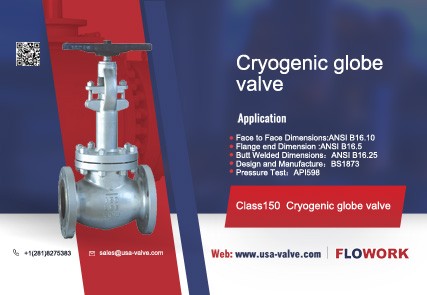
To survive, a cryogenic valve uses an extended-stem (long-stem) configuration that pushes the stem packing and actuator connection up and away from the cold body, keeping the sealing area above the frost line. The body is built from low-temperature grades such as 304L/316L austenitic stainless steel or low-temperature carbon steel (LF2/LF3), with seats in PTFE, PCTFE (Kel-F), or metal-to-metal hardfacing for bubble-tight shut-off.
For on/off isolation duties, Flowork's cryogenic ball valves combine an extended bonnet with bubble-tight soft or metal seats rated to −196 °C.
Where backflow prevention is critical, our cryogenic check valves maintain line integrity through repeated thermal cycling.
What makes the category distinct is not a single part but a complete design-and-qualification system: the materials, the bonnet length, the packing system, and — most importantly for your risk profile — the cryogenic valve test that proves the assembly works at the temperature it will actually see in service.

Why do cryogenic valves need special testing?
A valve can pass a perfectly good ambient-pressure test and still fail catastrophically in cryogenic service, because the physical assumptions behind that test no longer hold. Three things change when you drop from +20 °C to −196 °C: the body and bolting shrink and lose ductility, the sealing polymers stiffen and lose recovery, and the stem packing can cold-flow or crack. A leakage path that is invisible at room temperature can open wide once the valve is chilled and thermally cycled.
That is why a plain hydrostatic shell-and-seat test is not enough. Cryogenic valve qualification must verify the valve at or near its actual service temperature, confirm it still operates after cooling, and prove the seat seals against gas when cold. For your business, the consequence of skipping this is severe: a leaking LNG isolation valve is a flammability, personnel-safety, and regulatory-event risk, not a routine maintenance nuisance. Specifying a recognised cryogenic valve testing standard converts an unknown into an auditable acceptance record.
Material toughness is the other half of the story. Austenitic stainless steels lose yield strength as they cool but gain strength and notch toughness — provided the grade and heat treatment are correct. Cryogenic specifications therefore demand Charpy V-notch impact testing at −196 °C (typically ≥20 J average, no single specimen below 16 J under BS 6364), and low-temperature-rated bolting such as ASTM A320 Grade L7 with A194 Grade 4H nuts. You can review the underlying valve body materials and their rated low-temperature limits to see how grade choice maps to service temperature.
What temperature counts as cryogenic in valve service?
There is no single universal number, but the industry converges on a practical threshold. ASME B16.34 and most cryogenic specifications treat −50 °C (−58 °F) as the boundary between "low-temperature" and "cryogenic" service, and BS 6364 scopes cryogenic valves from −50 °C down to −196 °C. Anything warmer than −50 °C is usually handled by standard low-temperature-rated valves; anything at or below it should be specified, built, and tested as cryogenic.
The table below maps the common liquefied media you are likely to encounter to the temperatures your valve specification must cover. Note that the design temperature should be at or below the lowest expected temperature, not the average — a valve rated only to −101 °C is not acceptable for LNG at −162 °C.
| Service / medium | Typical temperature | Common cryogenic / low-temp valve types |
|---|---|---|
| Liquefied natural gas (LNG) | −162 °C | Cryogenic ball, gate, globe, check |
| Liquid nitrogen (LIN) | −196 °C | Cryogenic ball, globe |
| Liquid oxygen (LOX) | −183 °C | Cryogenic globe, ball (oxygen-cleaned) |
| Ethylene | −101 °C | Cryogenic ball, gate |
| Liquid CO₂ / propane | −46 to −51 °C | Low-temperature ball, gate |
| General cryogenic threshold | ≤ −50 °C | Cryogenic-rated valves (per BS 6364 / ASME B16.34 LT) |
What standards apply to cryogenic valve testing?
Four documents form the backbone of cryogenic valve qualification, and as a buyer you should know what each one does so your purchase order cites the right combination. The headline standard is BS 6364 (Specification for valves for cryogenic service, 1984), which remains the single most widely referenced procurement specification across global LNG projects — frequently listed as mandatory in project valve datasheets. It defines a per-valve factory test at liquid-nitrogen temperature, the mandatory 1.5× shell and 1.1× seat pressures, a helium seat-leakage limit, the −196 °C Charpy impact requirement, a ≥50 mm packing-box length, and the "CRYO" body marking.
The modern international counterpart is BS EN ISO 28921-1:2022 (Industrial valves — Cryogenic valves), with Part 2 covering type testing. Where BS 6364 mandates a test on every valve before shipment, ISO 28921 is a type-test scheme — first-article qualification plus periodic follow-up sampling — which often suits a manufacturer's product-certification path and carries broader jurisdictional recognition. API 598 (Valve Inspection and Testing, 11th edition 2023) is not cryogenic-specific; it sets the ambient-temperature baseline — the 1.5× shell test, 1.1× seat test, and leakage-rate classes — that a cryogenic valve must also pass before it is cooled down. Finally, MSS SP-134 fills the gap BS 6364 leaves open: it specifies body/bonnet extension dimensions and, in Annex A, a helium-based cryogenic test sequence with acceptance rates expressed in scc/min per NPS.
| Standard | What it covers | Role in cryogenic valve qualification |
|---|---|---|
| BS 6364:1984 | Valves for cryogenic service; scope −50 °C to −196 °C; per-valve factory test at LN₂ temperature | Most-cited LNG procurement spec; defines 1.5× shell / 1.1× seat, helium seat limit, −196 °C Charpy, ≥50 mm packing box, "CRYO" marking |
| BS EN ISO 28921-1:2022 | Cryogenic valves — Part 1 design/manufacturing/conformity; Part 2 type testing | Modern international route; type-test scheme (first article + periodic sampling) with wider recognition |
| API 598 (2023) | General valve inspection & testing — shell, seat, backseat, leakage classes | Ambient-temperature baseline (1.5× shell, 1.1× seat) every cryogenic valve must also pass |
| MSS SP-134 | Cryogenic service valves incl. body/bonnet extension dimensions; Annex A helium test | Defines extended-bonnet lengths and helium seat-leakage acceptance (scc/min per NPS) |
A useful way to think about it: API 598 proves the valve is a sound industrial valve at room temperature, BS 6364 or ISO 28921 proves it is a sound cryogenic valve at service temperature, and MSS SP-134 proves the bonnet extension is correctly proportioned for the cold zone. If you want to see how a standard industrial valve is verified before any low-temperature work begins, our explainer on how standard industrial valves are tested for quality and performance covers the ambient-pressure-test foundation these cryogenic tests build on.
How is cryogenic testing different from standard valve testing?
The short answer is that standard valve testing answers "does it hold pressure at room temperature?" while cryogenic valve testing answers "does it hold pressure, seal, and operate at the temperature it will actually see?" The test philosophy, media, and evidence set are fundamentally different, and the table below shows exactly where they diverge.
| Aspect | Standard valve test (e.g. API 598) | Cryogenic valve test (BS 6364 / ISO 28921) |
|---|---|---|
| Test temperature | Ambient (~20 °C) | Cooled to −196 °C in liquid nitrogen and held |
| Seat-leakage medium | Water / air at ambient | Helium or gas measured at cryogenic temperature |
| Functional check | Operated at ambient | Cycled at −196 °C to confirm cold operating torque |
| Material evidence | Standard material certificate | −196 °C Charpy impact + low-temp bolting (A320 L7) |
| Marking | Standard nameplate | Additional "CRYO" + lowest temp + standard number |
The practical takeaway for your specification is simple: do not accept an ambient test certificate as proof of cryogenic suitability. The two are complementary stages of one qualification, not substitutes for each other.
5 cryogenic valve tests every buyer should know
When you review a cryogenic valve test report, these five tests are the ones that separate a qualified valve from a box that merely looks the part. Make sure your purchase order names each one and defines its acceptance basis — by standard reference, not by vague promise.
| # | Test | What it verifies | Typical acceptance |
|---|---|---|---|
| 1 | Ambient shell (hydrostatic) | Body/bonnet pressure boundary at 1.5× rated pressure | No visible leakage (API 598) |
| 2 | Ambient seat & backseat | Closure tightness at 1.1× rated, both directions | Zero leakage (soft seat) / rated bubble count (metal seat) |
| 3 | Cryogenic cool-down + functional cycling | Operability at −196 °C; torque; smooth stroke | Torque ≤ ~1.5× ambient; smooth open/close |
| 4 | Cryogenic seat leakage (helium/gas) | Seat sealing at service temperature | Bubble-tight; helium ≤ ~1×10⁻ⁱ Pa·m³/s or per MSS SP-134 Table A1 |
| 5 | Cryogenic shell + material/marking review | Cold body integrity; toughness; traceability marking | No leakage; Charpy ≥20 J avg @ −196 °C; "CRYO −196 °C" marked |
| Get the cryogenic valve test checklist Turn these five tests into a purchase-order specification your suppliers cannot talk around. Download Flowork's buyer's checklist and see exactly what evidence to require for LNG and low-temperature valves. |
Cryogenic Testing Procedure of Valves
A properly documented cryogenic valve test follows a fixed sequence, and you should expect the test report to record temperature, pressure, duration, and result at every step. The procedure below reflects the BS 6364 / MSS SP-134 Annex A method that most LNG projects accept.
Step 1 — Ambient shell test. Fill the valve with water, close the ends, and pressurise to 1.5× the rated pressure at 38 °C. Hold for the size-dependent minimum (15 s for DN≤50 up to 300 s for DN≥350). No visible leakage through the pressure boundary is permitted.
Step 2 — Ambient seat and backseat test. Apply 1.1× rated pressure to each seat side in turn (and the backseat if fitted). Soft seats must show zero leakage; metal seats are judged against the applicable bubble-count class.
Step 3 — Cryogenic cool-down. Immerse or flood the valve body with liquid nitrogen and ramp the temperature down at a controlled rate (commonly ≤5 °C/min) to −196 °C. Soak until the valve and extended bonnet reach thermal equilibrium — typically 30 minutes of stable temperature per BS 6364 practice.
Step 4 — Cold functional cycling. With the valve at −196 °C, perform a minimum of four full open/close cycles. Record the cold operating torque and confirm it stays within roughly 1.5× the ambient value with no binding.
Step 5 — Cryogenic seat leakage. Apply the seat test pressure (typically 80 psig low-pressure helium, then the high-pressure seat pressure) and measure leakage with a mass-spectrometer or bubble counter. Acceptance is bubble-tight, or per the MSS SP-134 Table A1 helium rate for the class.
Step 6 — Cryogenic shell test and dry-out. Where specified, repeat the shell test at cryogenic temperature, then warm, drain, and dry the valve to prevent chloride-induced cracking of stainless bodies (test-water chloride is typically controlled below 30 ppm).

What failures does cryogenic testing catch?
The reason this disciplined procedure exists is that cryogenic service produces failure modes a room-temperature test will never reveal. The most dangerous is seat leakage when cold: a soft seat that recovers fine at 20 °C can lose elasticity at −162 °C, opening a path that only the helium seat test at temperature will expose. A second is packing or stem-seal leakage caused by packing hardening or cold-flow — invisible at ambient, but a direct fugitive-emission and safety hazard in LNG service.
Thermal cycling also exposes binding or excessive cold torque from differential contraction between the stem and body, and body or weld leaks that develop only under the combined stress of pressure and extreme cold. Material-level defects — insufficient Charpy toughness — show up as brittle fracture risk that the impact-test requirement is specifically designed to screen out. In short, cryogenic testing is the only stage in the evidence chain that proves the valve performs across its full thermal envelope, not just on the day it left the warm test bench.

How to choose a cryogenic valve supplier with real testing capability
As a buyer, your job is to distinguish a supplier who labels valves "cryogenic" from one who can prove it. Start with the test facility: do they operate an in-house liquid-nitrogen cryogenic test bench, or do they subcontract and only hand you a certificate? In-house capability means shorter lead times, test witnesses you can invite, and reports you can trust. Ask for a sample test report that records the cooling curve, soak time, cold torque, helium leakage value, and the signature of the inspector.
Next, check the documentation stack: material certificates with −196 °C Charpy values, low-temperature bolting certs (A320 L7 / A194 4H), the "CRYO" body marking, and traceability from heat number to final assembly. For LNG and air-separation duty, also confirm oxygen-cleaning (degreasing) certification where the medium demands it. Finally, verify the standards your project requires are actually named in their quality system — BS 6364, ISO 28921, API 598, and MSS SP-134 — rather than assumed. A supplier who can show you the cryogenic test bay, the impact-test records, and the marking practice is one your process safety team can approve with confidence.
FAQs
Is API 598 enough on its own for cryogenic valve testing?
No. API 598 is a general valve inspection-and-testing standard performed at ambient temperature. It establishes the baseline shell and seat tests every valve must pass, but it does not cool the valve or verify sealing at service temperature. A genuine API 598 cryogenic test reference in a spec usually means "test to API 598 at ambient, then qualify to BS 6364 or ISO 28921 at cryogenic temperature." Always specify both stages.
What is the difference between BS 6364 and ISO 28921?
BS 6364 requires a cryogenic test on every individual valve before shipment, which is why it dominates LNG project datasheets. ISO 28921-1 (with Part 2 for type testing) is a modern international standard based on a type-test scheme — first-article qualification plus periodic sampling — that often suits product certification and carries wider jurisdictional recognition. Many buyers accept either, provided the chosen route is named explicitly in the purchase order.
At what temperature does a valve need cryogenic qualification?
The practical threshold is −50 °C. Above that, low-temperature-rated valves per ASME B16.34 LT are usually sufficient; at or below it — including LNG at −162 °C, LIN at −196 °C, and ethylene at −101 °C — the valve should be specified, built, and tested as cryogenic under BS 6364 or ISO 28921.
What leakage rate is acceptable in a cryogenic seat test?
For soft-seated valves the expectation is bubble-tight (zero visible leakage). Where helium mass-spectrometer measurement is used, BS 6364 practice targets a seat leakage rate around 1×10⁻ⁱ Pa·m³/s or lower; MSS SP-134 Annex A expresses allowable helium leakage in scc/min per NPS and scales it by pressure class (for example roughly 25–50–100 scc/min/NPS for Classes 150/300/600). Always state the acceptance basis in your order.
Why does a cryogenic valve need an extended bonnet?
The extended (long) stem moves the packing box and stem seals up and away from the cold body so the sealing area stays above the frost line — above 0 °C — where packing remains elastic and operable. MSS SP-134 defines the extension lengths. Without it, the packing would freeze, the stem could bind, and the seal would fail in service.
Do all cryogenic valves require Charpy impact testing?
For valves built to BS 6364, yes — the body and bonnet materials must demonstrate Charpy V-notch impact energy of at least 20 J average at −196 °C, with no single specimen below 16 J. This screens out the brittle-fracture risk that ordinary material certificates do not address, and it is a standard line item in a compliant cryogenic valve qualification package.
Conclusion
Specifying cryogenic valves is less about picking a model and more about demanding proof. A recognised cryogenic valve testing standard — BS 6364 or ISO 28921, supported by API 598 at ambient and MSS SP-134 for the bonnet — turns a temperature-driven risk into an auditable acceptance record your safety and procurement teams can both rely on. Insist on the five core tests, require the cooling curve and helium-leakage values in the report, and choose a supplier with the in-house cryogenic test bench to back the "CRYO" marking on the body. Your business protects uptime, compliance, and personnel safety the moment you make cryogenic qualification a non-negotiable line in every valve datasheet.
| Talk to Flowork about your cryogenic valve specification Send us your datasheet, service temperature, and medium. We will confirm the right standard route, materials, and test scope — and quote against a fully documented cryogenic qualification package. |