English
 Español

Forged Valve Manufacturing Process: A Complete Guide
If you specify or purchase industrial valves, you already know that not all valve bodies are built the same way. The forged valve manufacturing process is the reason certain valves can survive high-pressure, high-temperature, and sour service conditions that would cause a cast valve body to fail. In this guide, you will learn exactly how FLOWORK forges valve bodies from raw billet to finished product, which materials and standards govern the process, and how to choose the right forged valve for your application.
What Is the Forged Valve Manufacturing Process?
The forged valve manufacturing process is a method of shaping a solid steel billet into a valve body using compressive force, heat, and controlled deformation — rather than pouring molten metal into a mold. When you choose a forged valve body, you are choosing a component with a continuous, unbroken internal grain structure, which is the main reason forged parts outperform cast parts under pressure and impact loading.
Forging vs Casting — The Core Difference
The core difference between forging and casting comes down to how the metal's internal structure forms. In casting, molten steel is poured into a mold and solidifies as it cools, which can leave microscopic voids, gas pockets, or inconsistent grain patterns inside the body. In forging, a solid billet is compressed under high pressure, and the grain flow follows the shape of the part instead of being interrupted. If your application involves cyclic loading, thermal shock, or high pressure, this structural difference directly affects how long your valve will last in service.
How Is a Forged Valve Body Made? Step-by-Step Process
You don't need to be a metallurgist to evaluate a supplier's forging process, but you should know what happens at each stage, because every step affects the final strength and reliability of your valve body.
Step 1 — Raw Material Selection & Billet Cutting
Your process starts with selecting certified steel billets that match the required material grade — for example, A105N carbon steel or F304/F316 stainless steel. The billet is cut to a specific weight and length using a saw or shear, based on the target valve body size. At this stage, you should ask your supplier for mill test certificates (MTCs) that trace the billet back to its heat number, since this traceability becomes important later for quality audits.
Step 2 — Heating and Forging (Open-Die vs Closed-Die)
The billet is heated to a forging temperature typically between 1,100°C and 1,250°C (2,012°F–2,282°F), which makes the steel plastic enough to deform without cracking. Two forging methods are commonly used: open-die forging, which uses flat or simple-shaped dies and is suited to larger or custom valve bodies, and closed-die forging, which uses a matched die set to produce high-volume, dimensionally consistent bodies. For your business, closed-die forging generally means tighter tolerances and lower per-unit cost at volume, while open-die forging offers more flexibility for large or non-standard sizes.
Step 3 — Heat Treatment (Normalizing / Quenching / Tempering)
After forging, your valve body still carries internal stress from the deformation process, so it must go through heat treatment. Normalizing refines the grain structure by heating the part and air-cooling it. Quenching and tempering — heating followed by rapid cooling, then reheating to a lower temperature — is used when higher yield strength is required. Skipping or shortening this step is one of the most common causes of premature cracking in service, so it's worth confirming your supplier's heat treatment furnace records for every batch.
Step 4 — Precision Machining and Boring
Once heat treated, the rough forged body is machined to its final dimensions — bore diameter, face-to-face length, flange facing, and end connections (flanged, socket weld, or threaded). CNC machining is used to hold tolerances typically within ±0.05 mm on critical sealing surfaces. This step determines whether your valve will seal correctly against its mating pipeline and gasket the first time it's installed.
Step 5 — Surface Treatment & Corrosion Protection
Depending on your service environment, the machined body may receive additional surface treatment: shot blasting to remove scale, phosphating, painting, or in some cases electroless nickel plating for corrosive media. If you're specifying valves for offshore, chemical, or coastal environments, ask specifically what surface protection is included as standard versus what requires an upcharge.
Step 6 — Inspection and Testing (NDT, Hydrostatic Test)
Before your valve body leaves the factory, it should undergo non-destructive testing (NDT) — typically ultrasonic testing (UT) or magnetic particle testing (MT) to detect internal or surface defects — followed by a hydrostatic shell and seat test per API 598. You should always request a copy of the test report and pressure test certificate before accepting delivery, especially for pressure-critical applications.
Why Choose Forged Steel Valves Over Cast Valves?
If your project involves high pressure, high cycling, or a size of DN100 (4") or smaller, a forged steel valve is very likely the better choice for your business. You can read a full breakdown in our article on the differences between cast steel valves and forged steel valves, but here is a direct comparison to help you decide.
| Factor | Forged Valve Body | Cast Valve Body |
|---|---|---|
| Grain structure | Continuous, follows part shape | Random, formed during solidification |
| Internal defect risk | Low (fewer voids/porosity) | Higher (porosity, shrinkage possible) |
| Typical size range | Up to DN100 / 4" (standard) | DN50 to DN1200+ (large sizes) |
| Pressure rating suitability | Excellent for high-pressure Class 800–2500 | Better suited to lower/mid pressure classes |
| Impact & fatigue resistance | Higher | Moderate |
| Typical lead time | Shorter for standard sizes | Longer (pattern/mold dependent) |
What Materials Are Used in Valve Body Forging?
The material grade you specify for your forged valve body determines its pressure-temperature rating, corrosion resistance, and cost. Three grades cover the majority of industrial applications.
Carbon Steel — A105N
A105N is the most widely used forging grade for general service valve bodies, offering a minimum yield strength of around 250 MPa (36,300 psi) and good performance from -29°C to 425°C (-20°F to 800°F). If your application is standard oil, gas, or water service without extreme temperatures, A105N is usually the most cost-effective choice for your business.
Stainless Steel — F304 / F316
F304 and F316 forgings are specified when your process media is corrosive or when you need better performance at both cryogenic and elevated temperatures. F316 additionally contains molybdenum, which improves resistance to chlorides and pitting corrosion — an important factor if your valves will handle seawater, chemical process fluids, or offshore media.
Low-Temperature Alloy Steel — LF2
LF2 is a low-temperature carbon steel forging grade rated for service down to -46°C (-50°F), commonly required for LNG, cryogenic, and cold climate pipeline applications. If your project specification calls out low-temperature impact testing (Charpy testing), LF2 is typically the default material selection.
What Standards Govern Forged Valve Manufacturing?
You should always confirm which standards your supplier's forged valves are certified to before placing an order, since these standards define dimensions, pressure ratings, and testing requirements.
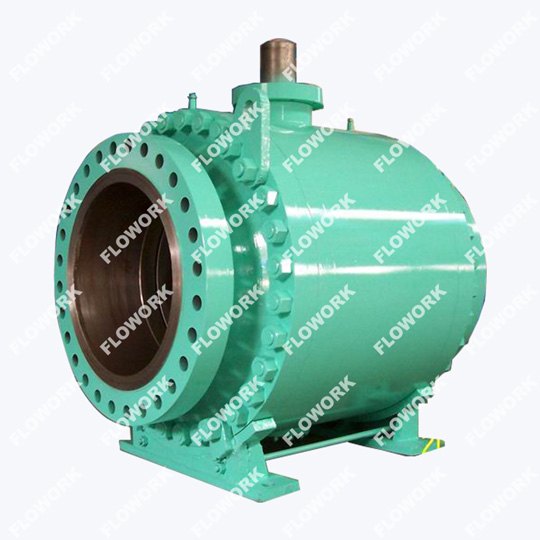
ASME B16.34 & ASME B16.5
ASME B16.34 governs pressure-temperature ratings, materials, and testing for valves, while ASME B16.5 governs flange dimensions and bolt patterns. Together, these two standards ensure your valve will physically fit and safely perform within your piping system's design conditions.
API 602 for Forged Steel Valves
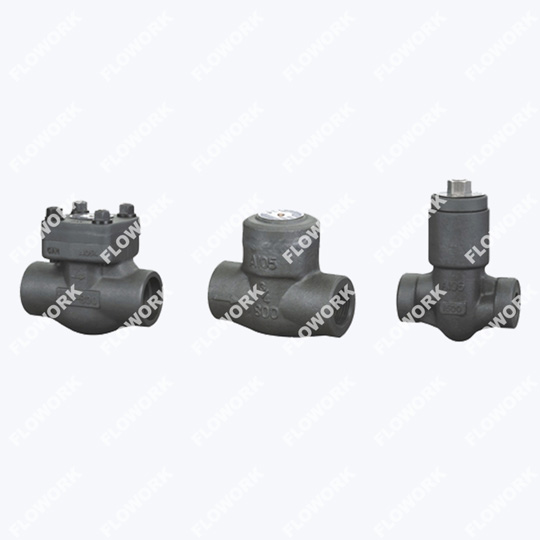
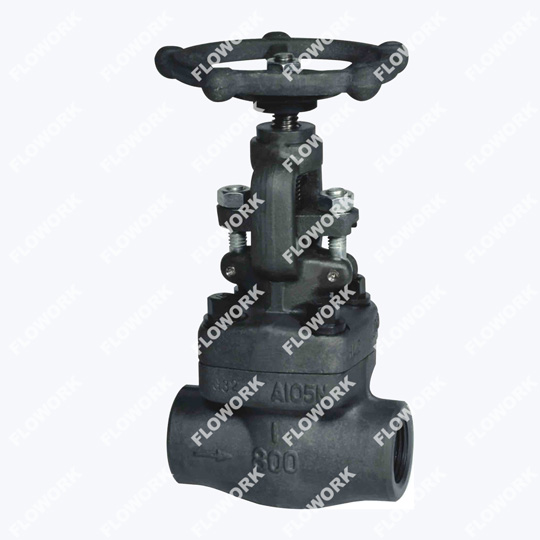
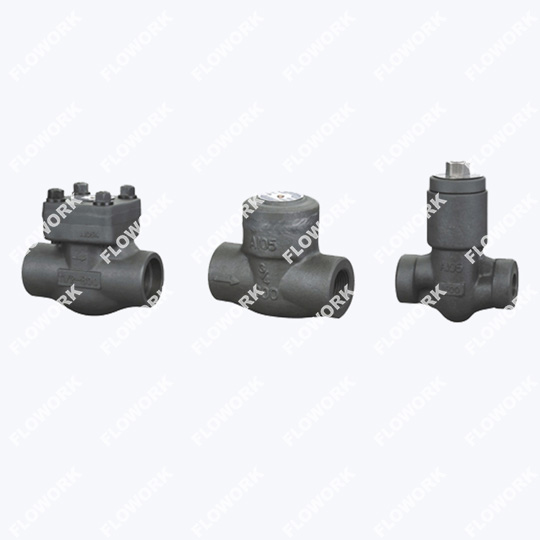
API 602 is the primary standard specifically for compact forged steel valves — typically gate, globe, and check valves up to DN100 (4"). Our API 602 forged steel check valves are manufactured to this standard, giving you dimensional consistency and compatibility across projects.
NACE MR0175 for Sour Service
If your application involves H2S-containing (sour) media — common in upstream oil and gas — your forged valve materials and hardness must comply with NACE MR0175/ISO 15156. This standard limits material hardness to prevent sulfide stress cracking, so you should specify NACE compliance explicitly if sour service is part of your operating conditions.
How to Choose the Right Forged Valve for Your Application?
Choosing the right forged valve for your business comes down to three practical questions.
Match Pressure Class and Temperature Rating
Start with your system's maximum operating pressure and temperature, then select a pressure class (typically Class 150 through Class 2500) and material grade that meets or exceeds those conditions with margin. Undersizing the pressure class is one of the most common — and most costly — specification errors.
Consider Size Limits (Typically ≤ DN100 / 4")
Forged valve bodies are generally manufactured up to DN100 (4"). If your line size is larger than that, you will typically need a cast valve body instead — which is why many B2B buyers standardize on forged valves for smaller, high-pressure branch lines and cast valves for larger mainlines.
Evaluate the Service Environment (Sour Gas, High Pressure, Cryogenic)
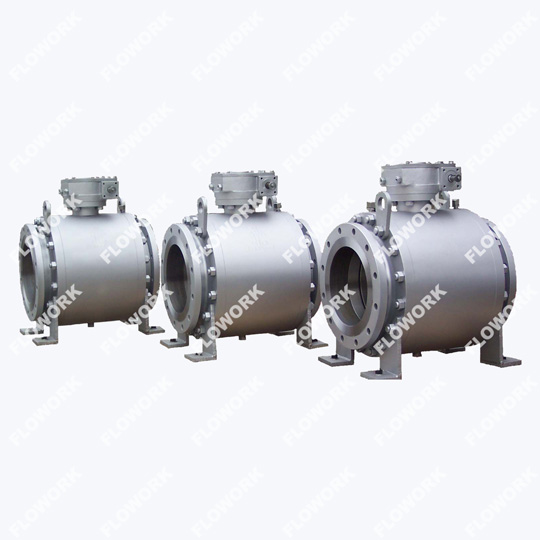
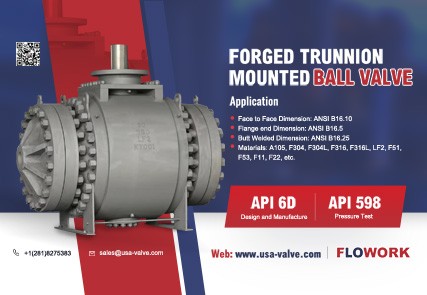
Match your material grade to your environment: A105N for general service, F304/F316 for corrosive or high-temperature media, and LF2 for cryogenic service. For applications like isolation and shutoff in compact piping, our forged ball valves are built to handle exactly this range of service conditions.
FAQs
What is the difference between forged and cast valves?
Forged valves are shaped by compressing a solid steel billet, giving them a continuous grain structure and fewer internal defects. Cast valves are formed by pouring molten metal into a mold, which is better suited to larger sizes but carries a higher risk of porosity.
What materials are commonly used for forged valve bodies?
The most common materials are A105N carbon steel for general service, F304/F316 stainless steel for corrosive or high-temperature media, and LF2 low-temperature alloy steel for cryogenic applications.
What is the maximum size for a forged valve?
Forged valve bodies are typically limited to DN100 (4") and below. Beyond this size, manufacturers generally switch to cast valve bodies due to forging equipment and cost constraints.
What standards apply to forged steel valves?
The key standards are ASME B16.34 for pressure-temperature ratings, ASME B16.5 for flange dimensions, API 602 for compact forged steel valve design, and NACE MR0175 for sour service applications.
How long does the forged valve manufacturing process take?
A standard forged valve body typically takes several weeks from billet forging through heat treatment, machining, and testing, though exact lead times depend on size, material grade, and order volume.
What is the difference between open-die and closed-die forging?
Open-die forging uses simple dies and suits larger or custom valve bodies with more flexible dimensions. Closed-die forging uses matched dies to produce high-volume parts with tighter, more consistent tolerances.
Are forged valves suitable for high-pressure applications?
Yes. Because forged valve bodies have a continuous grain structure and fewer internal defects, they are well suited to high-pressure classes, typically Class 800 through Class 2500.
What inspection and testing are required for forged valve bodies?
Forged valve bodies typically undergo non-destructive testing such as ultrasonic testing (UT) or magnetic particle testing (MT), followed by a hydrostatic shell and seat test in accordance with API 598.
What is A105 material, and why is it used in forged valve bodies?
A105N is a carbon steel forging grade with a minimum yield strength of around 250 MPa, suitable for -29°C to 425°C service. It is used because it offers reliable strength and cost efficiency for general industrial applications.
Can forged valves be used in sour service (H2S) environments?
Yes, provided the materials and hardness comply with NACE MR0175/ISO 15156, which limits hardness levels to prevent sulfide stress cracking in H2S-containing media.
Conclusion
The forged valve manufacturing process — from billet selection through forging, heat treatment, machining, and testing — is what determines whether your valve body will hold up under real operating pressure. When you understand each step, you can ask sharper questions of your supplier and specify a valve body that actually matches your application, rather than relying on price alone.
If you're evaluating forged valve bodies for your next project, our engineering team at FLOWORK can help you match material, pressure class, and standard to your exact operating conditions.